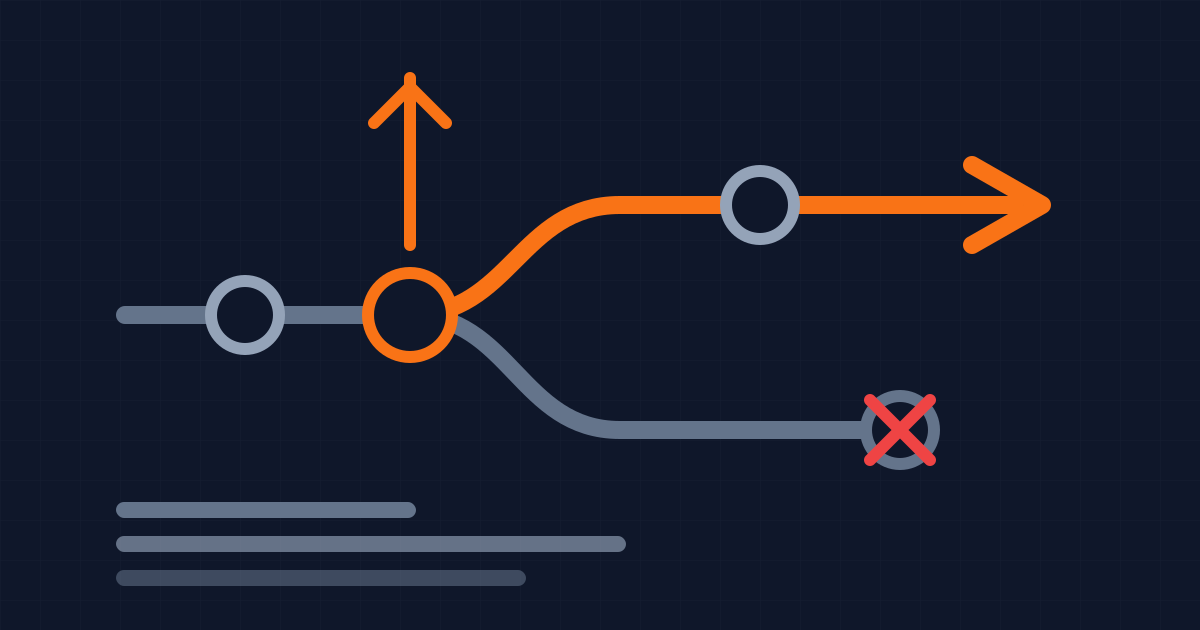
The important change in GPT-6 Astra is not another benchmark lead. It is that a long-running agent can take a correction while it is still working.
OpenAI released Astra on September 3, 2026, with three controls aimed at tool-heavy work: mid-turn steering, asynchronous tool calling and a persistent WebSocket mode for the Responses API. Together, they change the shape of an agent run. Your application no longer has to treat a request as a sealed box that can only be accepted or discarded after the model finishes.
That matters when an agent is browsing, editing code or operating software for minutes at a time. The longer a run lasts, the more likely its assumptions will become stale. A customer changes the priority. A human notices the wrong record. A tool returns a result that makes the original plan wasteful. Waiting for completion is not control.
The run becomes a live process
Mid-turn steering lets an application send new guidance while a response is in progress. The model incorporates that input into the same run rather than starting again from a blank request.
That sounds like a chat feature. Operationally, it is closer to changing a job while the job is running. If an agent is comparing suppliers and you learn that delivery date matters more than unit price, the useful action is to redirect the remaining search. Cancelling after the research is complete wastes both time and tool calls. Letting the stale plan continue produces a polished answer to the wrong question.
The design implication is easy to miss: steering needs a product surface. A human must be able to see enough of the current plan and tool activity to know when intervention is useful. A text box that accepts a correction but gives no indication of what the agent is doing is technically steerable and practically opaque.
Tools no longer have to form a queue
Asynchronous tool calling separates starting a tool from waiting for it. An agent can launch work whose result will arrive later, continue with independent steps, and consume the result when it becomes relevant.
This is most useful around slow systems: a data export, a repository scan, a browser task or an internal approval. The old pattern makes each wait part of one serial chain. The asynchronous pattern exposes a small scheduler inside the run.
That creates a responsibility for your application. Parallel calls need identifiers, deadlines and a clear policy for late results. If a steering message makes a pending call irrelevant, you need to cancel it where possible or mark its eventual result as stale. Otherwise concurrency only makes the wrong work happen faster.
It also changes evaluation. A final answer can look correct even when the path to it launched duplicate calls, ignored a timeout or used an obsolete result. Tests should record the event sequence, not only grade the last paragraph.
One connection can hold the working state
OpenAI's WebSocket mode keeps one persistent connection to the Responses API for long, tool-heavy workflows. It supports parallel conversations, forks and incremental input. A client continues a turn with new items and a previous response identifier instead of resending the entire exchange.
The practical gain is not that WebSockets are new. It is that the transport now matches an agent that stays active, branches work and receives input during execution. The release also preserves prompt caching when reasoning effort changes mid-conversation, according to the launch documentation.
Persistent state creates familiar distributed-systems problems. Connections drop. Clients reconnect. Events can arrive twice or in a different order than the interface expects. A production implementation still needs durable run state outside the socket, idempotency for tool side effects and a replay strategy for the user interface.
Do not let a persistent connection become the only record of what happened. Store the run identifier, steering inputs, tool requests, results and final disposition. That log is what lets you explain why an agent changed direction or acted on a particular version of the brief.
What changes for teams shipping this quarter
Start by separating intervention from cancellation. A stop button is still necessary, especially before a side effect, but it should not be the only control. Add a way to correct the goal, narrow scope or replace a bad assumption without losing useful completed work.
Then define which tool calls may overlap. Read-only research is usually easier to parallelise than payments, deployments or record updates. Side-effecting tools need explicit ordering and confirmation even when the model can call them asynchronously.
Finally, evaluate recovery. Drop the WebSocket during a run. Deliver a steering instruction after a slow tool was launched. Return two results in the opposite order. Restart the client and verify that the user can still understand the current state. These tests reveal more than another set of ideal prompts.
OpenAI reports that Astra completed its OSWorld tasks in roughly 40 minutes versus roughly 75 minutes for GPT-5.6 Sol, while also scoring higher in that evaluation. Those are vendor-run benchmark and simulation results, not a latency guarantee for your workflow. Your useful measure is how much work survives a correction, a disconnect or a changed requirement.
What this does not change
Interruptibility is not permission control. A steerable agent can still have access to a tool it should never use. Keep authorization, confirmation and least privilege outside the model.
It is not reliability by itself either. Async calls and persistent sessions add states that your application has to observe and recover. Without event logging and idempotent tools, the new controls can make failures harder to reconstruct.
Availability is also limited during rollout, and the API features require the Responses API. Teams using another interface do not gain these controls merely by changing a model name.
The release gives developers better primitives for an uncomfortable fact: useful agent work is long enough for reality to change underneath it. The engineering job is to make that change visible, correctable and safe.
Written by Dandelion Labs